

Let's explore the correct way to boil beets in a pot, speeding up the preparation process for salads. We'll learn how to pick the best beet variety, determine the cooking time, find out when the beets are done, and discuss storing cooked beets.
Choosing Beet
The key to a delicious dish starts with the right choice of beets. Look for fresh, young, heavy, firm, and elastic roots with thin burgundy skin, free from damage, dents, and dark spots. For boiling, salad preparation, and borscht, select varieties high in sugar and rich in color, such as "Bordeaux," "Cylinder," "Mona," "Tenderness," "Mulatto." These varieties are suitable for stovetop cooking and baking in the oven, preparation in a multicooker, or steaming. The quickest and easiest way to cook beets is in the microwave, but a pressure cooker is another fast method.
Ingredients for 1 portion

- 3 whole Beet medium or large
- 8.5 cup Water (2000 ml)
Additional
- 1 tsp White wine vinegar
- 1 tsp Sugar
- 1 tbsp Lemon Juice
- 1 slice Rye Bread (20 g)
- 2 tbsp Vegetable oil
How to cook

Method 1: Standard Pot Boiling
Wash beets of equal size well to remove dirt. The vegetables can be soaked in cold water to remove stuck dirt. You can wash the beets under a stream of cold water using a soft brush. The main thing is not to damage the skin of the beets.
If the beets have tops, cut them off, leaving about ½ inch (1 cm). Do not cut off the root ends. The more damage on the beet skin, the more it will lose color and taste during cooking. After cooking, beets that are peeled or damaged become tasteless, pale, and watery. That's why it's better to boil even large beets whole. Unfortunately, the beets I bought were already without root ends.
Choosing dense, firm, young specimens with thin burgundy skin without damage is better for boiling beets in their skin. Beets for boiling should be medium size, at most 3-4 inches (8-10 cm) in diameter.
Old or dried-out beets can be revitalized by washing them well and blanching them with boiling water. Then, fill them with water at room temperature and let them swell. After that, boil them in the same water.

Place the beets in a tall pot and cover them with cool water. Then, cover the pot with a lid and place it over medium heat.
The water should cover the beets by 1-1.5 inches (3-4 cm). This is to avoid having to add more water as it evaporates. Moreover, a sufficient amount of water ensures even cooking of the vegetables.
Do not throw beets into boiling water. This method will not speed up the cooking process. The sudden temperature contrast outside and inside the beets leads to uneven cooking.
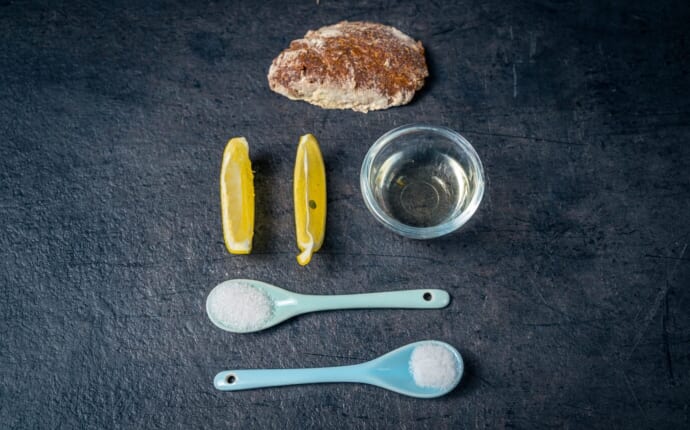
Boiling beets in a pot can be done with various additives. Let's figure out what you can add and why.
Vinegar, citric acid, lemon juice: An acidic environment helps preserve the color of beets. For the same purpose, a drop of vinegar is added to the dressing for borscht. Adding acid to cold water in moderate amounts is important: 0.5-1 tsp of vinegar per quart of water or a pinch of citric acid. Remember, acid can partially neutralize the sweetness of the beets.
Sugar: If you have unsweet beets, add sugar to the water: 1 teaspoon per quart of water (liter) . It improves the taste of the cooked beets. Sugar can also be added to neutralize the effect of vinegar.
The crust of rye bread: While the beets boil in the pot, the kitchen inevitably fills with a specific smell. If you add a crust of rye bread to the pot, it partially neutralizes this aroma.
Salt: You cannot cook beets with salt. Salt makes the cooked beets denser and harder. Moreover, sodium increases the cooking time.

Place the pot with beets over medium heat and cover with a lid. After the water boils, reduce the heat to a minimum. Boil the beets on low heat until done. The water should simmer very gently. A gentle simmer ensures even heating and doneness of the vegetables.
If part of the water evaporates during cooking, add boiling water.

The cooking time for beets depends on their size. On average, they are boiled for 40-60 minutes after the water boils.
After the water boils, small beets with a diameter of up to 2 inches (5 cm) are cooked for 20-30 minutes, small ones up to 3 inches (8 cm) for 30-40 minutes, medium ones 3-4 inches (8-10 cm) for 40-60 minutes, and large ones more than 4 inches (10 cm) for 60-90 minutes.
The freshness and variety are also important. Dense, juicy beets from the garden will be done much faster than last year's harvest. Moreover, the thicker the skin of the beets, the longer they take to cook.
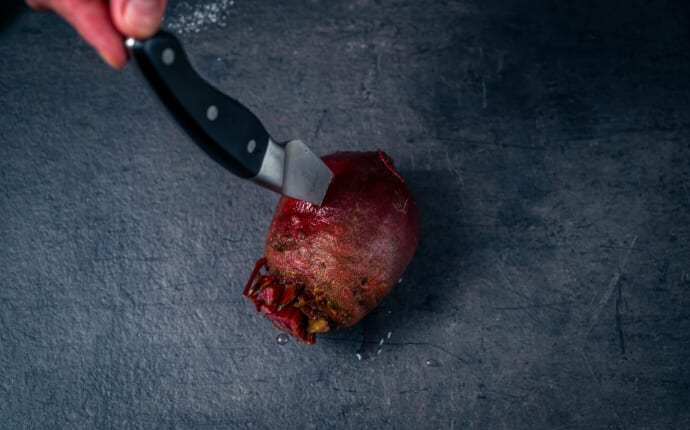
You can determine if boiled beets are done using a knife, toothpick, or fork. If the beet is easily pierced, it is done.
It's necessary to check doneness as close to the end of cooking as possible to avoid frequently piercing the vegetable. This helps preserve the skin's integrity and the beets' rich color.

As soon as the beets are done, put them in ice water.
Thanks to this procedure, we stopped the cooking process, and the beets retained their bright color. Moreover, thanks to the temperature contrast, the skin is easily cleaned with a light touch from a finger.
Do not overcook the beets or leave them in hot cooking liquid. Overcooked beets become mushy, lose taste, color and nutrients.

Method 2: Express Boiling (Shock Method)
To speed up the cooking process, you can use the express method. However, only some know how this technique works.
Place the clean beets in a pot, cover with cold water, and place over heat. Boil the beets for 30 minutes after the water boils. Add a couple of tablespoons of vegetable oil to the pot to create an oil film. The oil film reduces the evaporation process and slightly increases the water temperature.
Based on my experience, the cooking time depends on the size of the beets.

Place the partially cooked beets in ice water for 10-15 minutes. The colder the water, the better, so you can add ice cubes.
Many say that beets become tender due to the temperature difference, but this is not entirely true. You can only cook beets by the express-boiling method if the inside of the beet reaches a temperature of 212°F (100°C).
A bit of chemistry
At 212°F (100°C), protopectin, extensin, and hemicellulose undergo destruction (irreversibly break down). During the cooling of the beets, cellulose and hemicellulose partially restore their structure and release the absorbed moisture during swelling (additional liquid appears in the cell walls; moisture from the cells themselves also contributes). As a result, soluble products formed during the destruction of hemicellulose, protopectin, and extensin turn into a solution (combined with the liquid in the cell walls). As a result, the strength of the cell walls decreases (the beets become tender).

Method 3: Vacuum Sealing (Sous-Vide Style)
To preserve the bright color and rich taste, boil beets using a vacuum sealer.
Vacuum allows for a gentler cooking of the product. It also saves from dirty dishes and unpleasant smells.
The cooking time for vacuum-sealed beets is the same as for regular ones. Based on my experience, adding water to the pot with a margin is better. You may also encounter the beets floating. Therefore, you can use a small weight. And most importantly, vacuum-seal the beets in plastic designed for thermal processing. You can also use a roasting bag.

After the ice bath, the skin of the beets can be cleaned with a light movement of the finger.
If beet juice has stained your hands, the skin can be lightened with fresh apple peel.
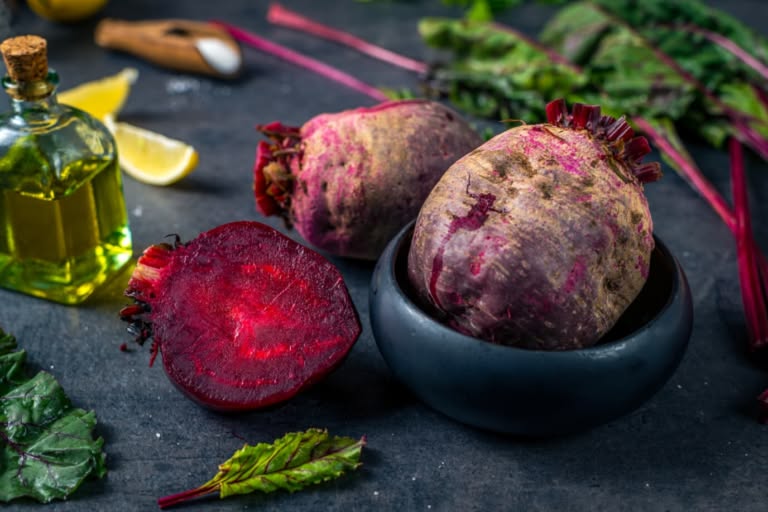
Boiled beets are ready to use.
Recipe Tips
How to store cooked beets
Beets don't like long storage in the fridge. Boiled, unpeeled beets can be stored in the refrigerator in an airtight container for 2 to 3 days. With longer storage, they lose their taste qualities. A vacuum sealer can extend this period to 2 weeks.
How to choose the best beets for boiling?
Look for small to medium-sized beets, ideally between 2-4 inches (5-10 cm) in diameter, as they tend to cook more evenly and quickly. Choose firm, heavy beets with smooth, unblemished skin and preferably with their greens still attached (they should look fresh, not wilted). Avoid beets with soft spots, bruises, or shriveled skin.
Can I use other types of beets, like golden or Chioggia?
Absolutely! The boiling methods described here work well for all types of beets. Golden beets won't bleed like red beets, and Chioggia (candy stripe) beets have beautiful patterns, though the color contrast might fade slightly upon cooking. Cooking times should be similar based on size.
Why shouldn't I peel or trim beets completely before boiling?
Leaving about ½ inch (1 cm) of the stem and the root end intact, along with keeping the skin on, helps prevent the beets from "bleeding" their color and flavor into the cooking water. This results in more vibrant, flavorful, and nutrient-rich cooked beets. They are much easier to peel after cooking anyway!
Help! My hands are stained pink!
eet juice stains! To minimize staining, you can wear disposable gloves while peeling and handling cooked beets. If your hands do get stained, try rubbing them with lemon juice or the cut side of a raw potato. Washing with soap and water immediately also helps.
Leave a Comment