

We're making authentic, classic Korean-style carrots. Morkovcha is a spicy, zesty, and incredibly delicious appetizer made from fresh carrots, garlic, coriander, vinegar, and oil. It has a sweet and sour, spicy flavor with a garlicky aroma and a juicy, crunchy texture. Korean-style carrots are served as an appetizer, as a side dish to meat dishes, used in making shawarma, hot dogs, and salads. It looks beautiful on a holiday table, at picnics, and is perfect for vegetarians and Lenten meals.
Remarkably, no one in Korea itself suspects the existence of Korean-style carrots. This dish was invented by Korean emigrants living in the territory of the former Soviet Union (Koryo-saram). Unable to find traditional ingredients for preparing panchans and kimchi, they used local carrots to prepare a similar dish. Morkovcha turned out to be such a successful invention that it quickly won hearts and became one of the most popular Korean cuisine appetizers in the former USSR.
Preparing Korean-style carrots at home so they taste just like the ones from the market is very easy and won't take much time. All we need is juicy, sweet carrots, fresh garlic, onions, oil, vinegar, the right set of spices, and a few preparation secrets.
Ingredients for 5 portions

- 2 lb Carrot (1 kg)
- 1 tsp Salt
- 1 tbsp Sugar
- 2 tbsp White wine vinegar
- 4 cloves Garlic
- 1 medium Onion
- 1/2 cup Vegetable oil
- 2 tsp Ground coriander
- 1/2 tsp Ground black pepper
- 1/2 tsp Сayenne pepper (to taste)
- 2 tbsp Soy sauce (optional)
How to cook

Peel the carrots and grate them on a special grater for Korean salads. It's better to grate the carrots along their entire length, this way they turn out more juicy and appetizing. Long carrots can be cut in half into pieces 3-4 inches (7-10 cm) in length to get more uniform julienne strips.
If you don't have a special grater, then the root vegetable can be cut into long thin julienne strips with a knife or grated on a regular large-hole grater.
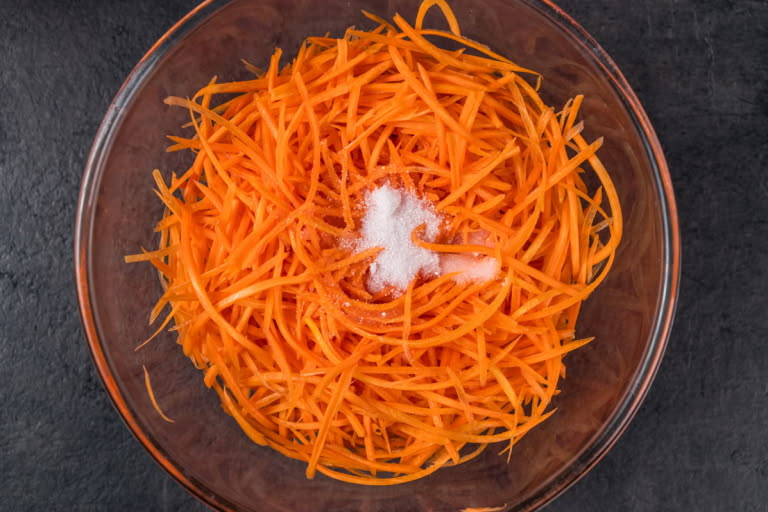
Put the carrots in a large bowl, add salt, sugar, and vinegar. Mix well and gently knead by hand until the sugar and salt crystals completely dissolve.
Leave the carrots for at least 30 minutes so they release their juices.
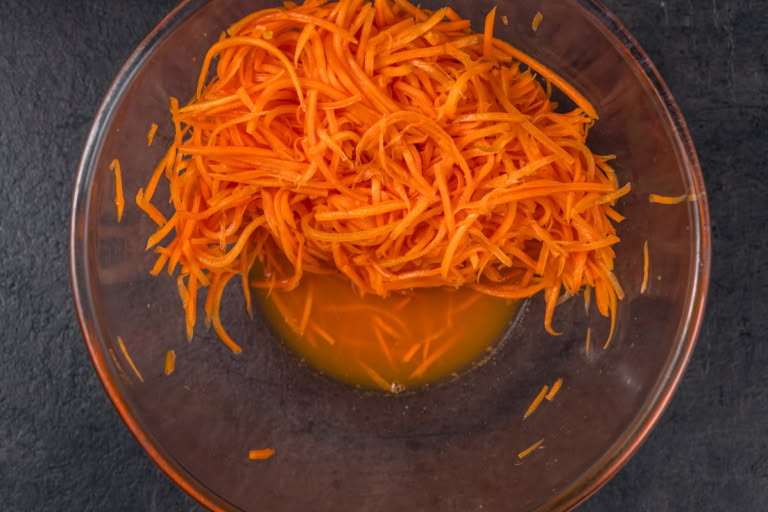
Drain all the juice, gently squeezing the vegetables by hand.
Tip. You can immediately put the carrots in a large strainer so the juice drains down freely.
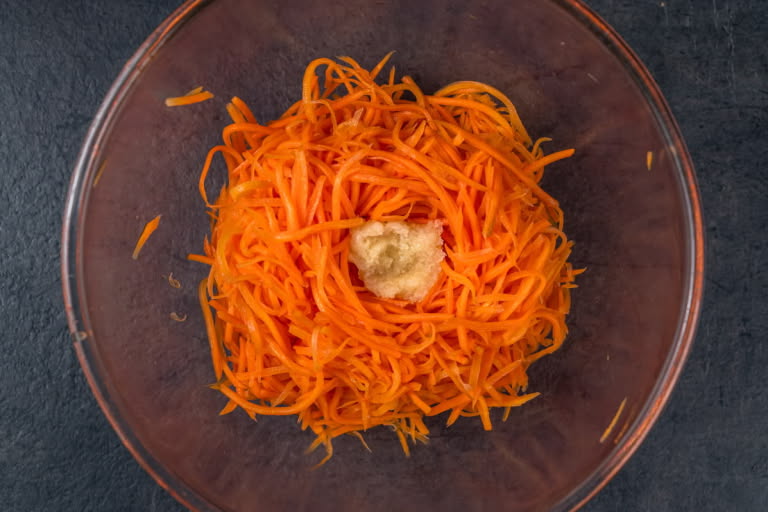
Pile the carrots into a mound, making a depression in the center shaped like a volcano crater. Add the peeled and pressed garlic to the center of the depression.
Tip. To get rid of the persistent garlic smell, remove its core.
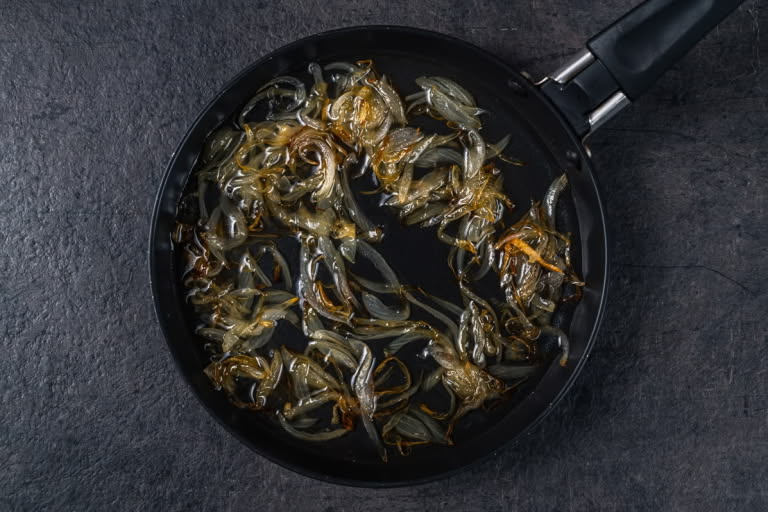
Coarsely chop the onion and fry it in heated vegetable oil until a beautiful golden color over moderate heat. Then remove the fried onion from the oil, we won't need it anymore, its only purpose is to flavor the oil.
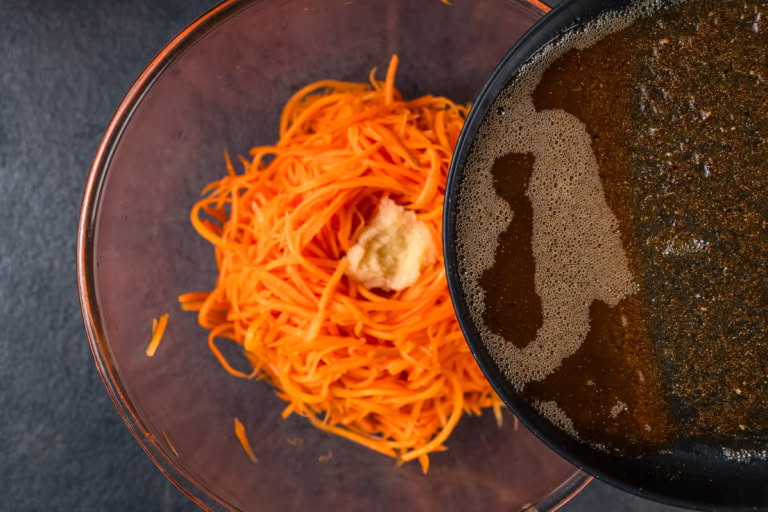
Add ground coriander, ground black pepper, and hot pepper to taste to the hot oil. Heat the spices over moderate heat for about 30-40 seconds. The temperature of the hot oil should be within 300-340°F (150-170°C), and the oil should not burn.
If desired, you can add sweet paprika, it gives the dish a beautiful color.
Tip. It's better to use freshly ground, pre-heated spices. For this, whole coriander seeds and black peppercorns need to be heated in a dry skillet, then ground with other spices in a coffee grinder or mortar and pestle.
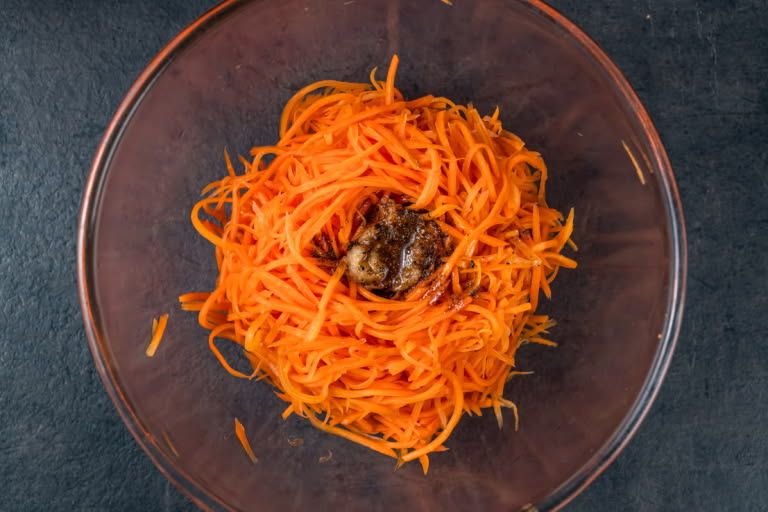
Pour the hot oil directly onto the garlic, this will help it release its aroma and slightly soften its bitterness. Mix the salad well.
If desired, you can add soy sauce. It's not a mandatory component of Korean-style carrots, but I like its mild flavor. Soy sauce is rich in glutamates and is a natural flavor enhancer.
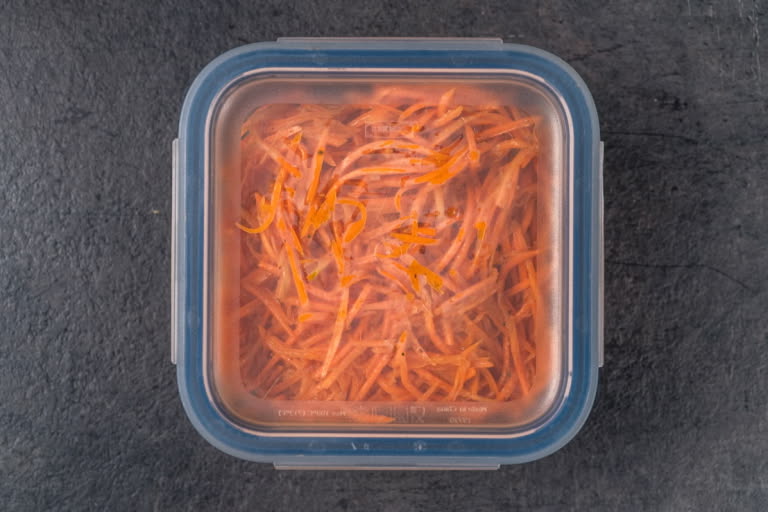
Put the carrots along with the marinade in a convenient container, cover with an airtight lid and put in the refrigerator for 3-4 hours, or better yet overnight. The longer the morkovcha marinates, the more delicious it becomes.

Korean-style carrots are ready.
When serving, the appetizer can be sprinkled with freshly toasted sesame seeds. Korean-style carrots can be served as an appetizer, salad, or side dish to meat, poultry, and vegetables.
Morkovcha should be stored in the refrigerator in an airtight container for 1 week.
Recipe Tips
What's Better to Use – Regular Vinegar or Essence?
When I'm making my Korean-style carrots, I find it best to use a 6% or 9% acidity vinegar. It has a milder flavor, it's much easier to work with, and it allows me to easily control the acidity of the final dish. Here’s why, in my opinion, regular vinegar is better than highly concentrated vinegar essence:
- It's ready to use. Unlike vinegar essence, which you have to dilute with water, regular vinegar is good to go right out of the bottle.
- It's easy to measure. You can follow the recipe precisely or add it to taste. Vinegar essence is so concentrated that you have to add it very, very carefully to avoid making the dish overwhelmingly sour.
- It distributes evenly. Regular vinegar spreads nicely over all the carrots, ensuring a consistent and balanced flavor. If you’re using undiluted concentrate, it’s much harder to get that small amount evenly mixed with all the ingredients.
- It's safer. Concentrated essence can be quite harsh. If you're not careful, it can irritate your skin or mucous membranes.
- Natural vinegars offer better flavor. I find that natural vinegars have a softer, more natural taste and often a pleasant fruity aroma that makes the finished dish more interesting and richer. Distilled white vinegar (often called "table vinegar" in some regions) and diluted vinegar essence are typically produced in a way that results in a sharper, more straightforward acidic taste without those lovely fruity notes.
If you happen to only have concentrated vinegar essence (usually 70-80% acidity) on hand – which is not very common in US home kitchens but you might encounter it – you'll need to dilute it properly with water to get a 6% or 9% vinegar solution before using it. To help you with this, I've created a handy Vinegar Dilution Calculator.
What Kind of Vinegar Is Best to Use?
Personally, I prefer to use a natural 6% apple cider vinegar or white wine vinegar. In my view, though, almost any vinegar can work for Morkovcha, depending on your taste preferences. It's worth noting that most common vinegars you'll find in US supermarkets (like distilled white, apple cider, and white/red wine vinegars) typically have 5% acidity. This 5% acidity vinegar will work beautifully in this recipe. The carrots might have a slightly milder tang than if you used a 6% or 9% vinegar, but they'll still be delicious. If you like a stronger sour note, you can simply add a little more of the 5% vinegar, tasting as you go.
Here are some good options:
- Distilled White Vinegar (typically 5% in the US, sometimes labeled "Table Vinegar" in other regions): This is essentially a water-based solution of acetic acid. It has a pretty sharp vinegar taste and smell, is completely clear, and makes a good base for marinades because it doesn't have any other "interfering" flavors.
- Apple Cider Vinegar (typically 5%): This one has a mild, slightly fruity flavor and a less aggressive acidity. Your finished carrots will be pleasantly sour without a harsh, sharp bite.
- Wine Vinegar (White or Red, typically 5-7%): Offers a soft, more refined taste with subtle fruity notes. You can use either the red or white variety.
- Rice Vinegar (or Cane Vinegar): These tend to have a very mild, delicate, and often slightly sweet taste.
I generally don't recommend using vinegars with very strong, dominant flavors and aromas, as they can easily overpower all the other wonderful ingredients in your Morkovcha. For example, balsamic vinegar, lemon-infused vinegar, truffle vinegar, basil vinegar, or other vinegars infused with strong herbs and aromatic products might not be the best fit here.
Using Lemon Juice
Instead of vinegar, or in combination with it, you can also use fresh lemon or lime juice. This is a great way to make Korean carrots with a very soft, delicate flavor and a lovely citrusy aroma. Plus, using citrus juice might even allow you to reduce the amount of sugar in the recipe a bit.
Ultimately, for your Korean-style carrots, you can use any type and amount of acidic ingredients you like, adjusting them to suit your personal taste.
Remember, vinegars can have different concentrations: the higher the percentage of acetic acid, the less of it you'll need.
Also, if you change the amount of acid in the recipe, you should also think about adjusting the amount of sugar. They work together to balance each other out, and getting that balance right is what gives you that perfectly delicious, well-rounded flavor in the final dish.
What kind of grater is best for Morkovcha?
The recipe mentions a "special grater for Korean salads," often called a julienne peeler or a mandoline with a julienne blade. This creates those lovely long, thin, uniform strips that are characteristic of Morkovcha and give it that perfect crunchy, juicy texture. If you don't have one, don't worry! You can carefully cut the carrots into thin julienne strips with a sharp knife. Alternatively, you can use the large holes of a standard box grater, though the strands will be shorter and the texture slightly different, but still delicious!
What type of carrots should I use?
For the best Morkovcha, you'll want to use juicy, sweet carrots. Look for firm, bright orange ones. As mentioned in Step 1, grating them along their entire length (or cutting longer carrots into 3-4 inch segments before grating) really helps to get those appetizing, uniform julienne strips that make the salad so appealing.
Why do I need to drain the carrot juice?
One of the key secrets to truly delicious and aromatic Morkovcha is getting rid of the excess carrot juice that's drawn out during the initial salting and sugaring stage (Step 2). Carrots release a lot of liquid when they sit with salt and sugar. If you don't drain this juice (Step 3), it can actually hinder the marination process and lead to a watery salad.
Here's why draining the juice is so important:
- Prevents Dilution: The carrot juice dilutes the marinade, making it less concentrated and flavorful.
- Avoids Separation: Excess liquid can cause the marinade ingredients to separate. You might notice the oil floating on top and the spices sinking to the bottom, rather than everything coating the carrots evenly.
- Maintains Texture: Draining helps the carrots maintain a pleasant crunch, rather than becoming soggy. If left in too much liquid, especially during longer storage, the carrots can become soft and waterlogged, much like vegetables that have been soaked in water for too long.
- Improves Flavor Absorption: Removing excess water allows the carrots to better absorb the flavorful marinade (the spiced oil and vinegar). It actually speeds up the marination process because the spices have an easier time penetrating the carrot strands.
So, instead of a potent marinade of oil and spices clinging beautifully to each carrot strand, you'd end up with a lot of diluted carrot juice. Don't squeeze them bone dry, just a gentle but firm press to remove the released liquid is perfect. Some people even save this slightly sweet carrot juice for other uses, like adding to smoothies!
How to properly remove the excess juice: After you've mixed the grated carrots with sugar and salt (and vinegar, if you're adding it at this stage), let them sit for 30-60 minutes. You'll see a good amount of liquid accumulate. Then, gently but firmly squeeze the carrots by hand to drain it off. This step is crucial for the best texture and flavor!
My Morkovcha is too spicy! How can I fix it?
If you've accidentally made your Korean carrot salad too fiery, don't despair! There are several ways to tone down the heat:
If it's very, very spicy:
- Add more carrots: Grate more carrots into the salad. Then, add the other marinade ingredients (sugar, salt, vinegar, oil, coriander, black pepper – everything except more hot pepper!) in proportion to the new amount of carrots. Mix well and let it marinate again.
- Dilute with other ingredients: Mix in other, milder ingredients. Good options include cooked and diced potatoes, blanched onions (briefly scalded in hot water to reduce their sharpness), chopped bell peppers, grated daikon radish, or even some grated apple or pear for a touch of sweetness.
- Repurpose it: Use the overly spicy Morkovcha as a smaller component in other dishes where its heat will be diluted. It can be great in shawarma, hot dogs, or mixed into larger, milder salads. Alternatively, serve it with a very neutral side dish like plain rice or unseasoned potatoes to help balance the heat.
If it's moderately too spicy:
- Add nuts: Stir in about 1/4 cup of finely chopped walnuts (around 5-7 nuts). The fats in nuts can help mellow the spice.
- Add sweetness: A little more sugar or a drizzle of honey can help counteract excessive spiciness.
- Add acidity: A bit more vinegar or lemon juice can sometimes help balance out the heat.
- Add oil: A little extra vegetable oil can help reduce the impact of capsaicin (the compound that makes peppers spicy) on your taste buds.
- Let it rest longer: Sometimes, simply letting the salad marinate for another 12-24 hours can help. The spices will distribute more evenly, and the initial punch of heat might mellow out a bit.
A clever trick: If you happened to save the carrot juice that you drained off earlier (after salting/sugaring the carrots), try adding some of it back into the overly spicy salad. The juice can absorb some of the excess spice and help rebalance the flavors.
How long should I marinate the Morkovcha?
The best taste richness you will achieve after a full day of marinating.
- Minimum Time: 3-4 hours is the minimum for the carrots to partially marinate and the flavors to start developing.
- Optimal Time: For a more pronounced aroma and flavor, 6-8 hours is even better.
- Ideal Time: Morkovcha truly shines when it has at least 10-12 hours, or even better, a full 24 hours (made a day ahead) for all those wonderful flavors – the garlic, coriander, pepper, vinegar, and sweetness – to meld together and fully penetrate the carrots. The texture also benefits from this extended marination. This is when it becomes incredibly rich and tasty!
If you're in a hurry: You can technically eat it after just 1-2 hours in the refrigerator. It will have cooled down, released some initial juice, and started to absorb the marinade. The carrots will be crunchier, and the marinade flavor will be more on the surface rather than deeply infused, but it will still offer a taste of what's to come.
I find Morkovcha is at its absolute peak deliciousness within the first 2 days. After about 48 hours, while still good, it will gradually start to lose some of its crispness and the flavors might begin to subtly change.
| Nutrition (per 100 g) | |
|---|---|
| 8 g | Fats |
| 9 g | Carbs |
| 1 g | Proteins |
| 110 ccal | Calories |
Leave a Comment