

Béchamel is a basic French sauce, one of the 5 mother sauces of French cuisine. It serves as a base for more complex sauces and is a key element in numerous dishes. The sauce has a silky, smooth texture and a neutral, creamy taste.
To make béchamel, also known as white sauce, we'll use just three ingredients: milk, all-purpose flour, and butter, and two simple cooking techniques: emulsification and thickening the sauce using a roux. Despite the terminology, making this sauce is quite simple.
Ingredients for 1 portion
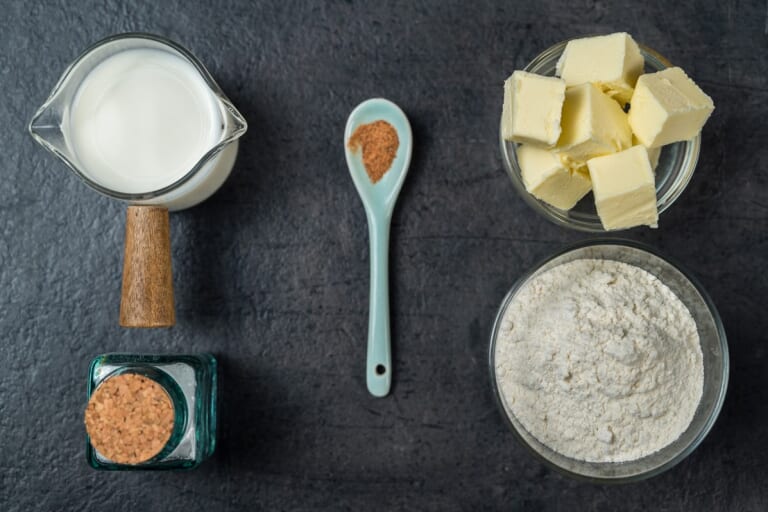
- 4 tbsp Butter (60 g)
- 1/2 cup All-purpose flour (60 g)
- 4¼ cup Whole Milk (1 l)
- 1/2 tsp Salt
- 2 pinch Ground nutmeg
Béchamel Sauce (White Sauce) Recipe
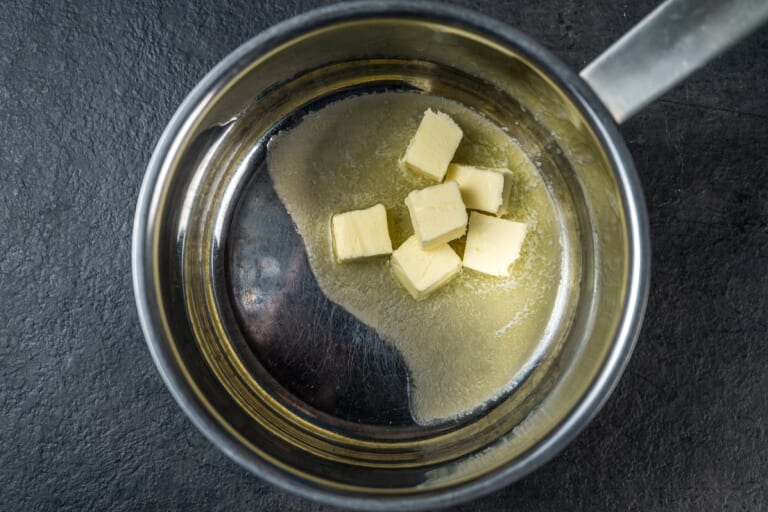
Place butter in a saucepan and melt over medium heat.

Add all-purpose flour and cook together over low heat for 1-2 minutes, stirring constantly.
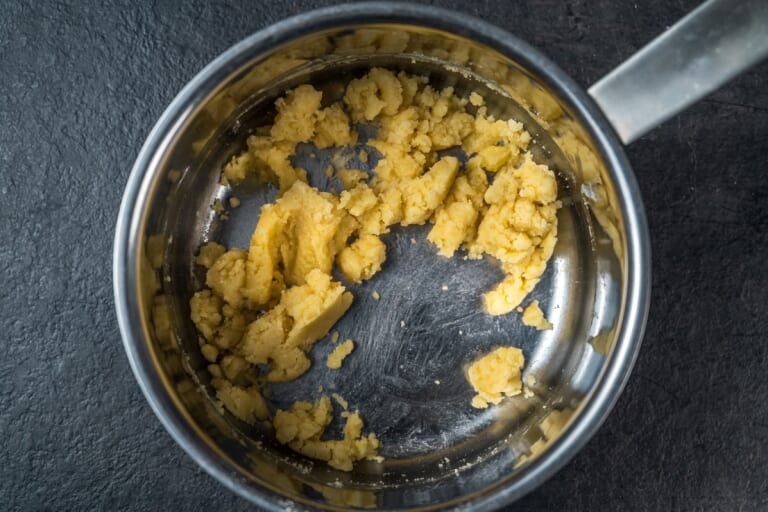
Our goal is to make a white roux. To do this, we need to cook the flour in butter until the raw flour smell disappears, but it shouldn't turn golden. Additionally, cooking the flour helps prevent lumps from forming in the sauce.
Classic Béchamel is thickened using a roux - a paste made from equal parts by weight of flour and butter. I use 4 tablespoons (60g) of butter and ½ cup (60g) of flour, which results in a medium-thick béchamel. By adjusting the ratio of roux to milk, we can make a thicker or thinner sauce.
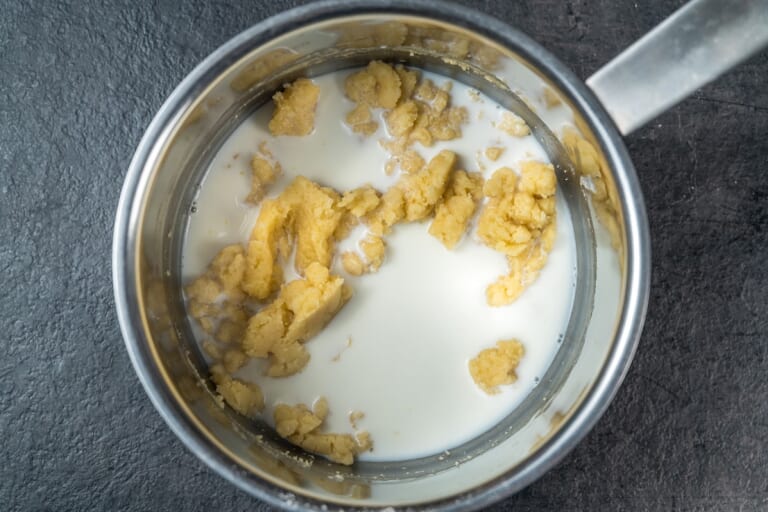
Add ¼ - ⅕ of the hot whole milk to the cooked flour in the saucepan and stir until smooth.
Important note: Béchamel requires cooking over very low heat and constant stirring. You need to stir the sauce thoroughly to prevent it from sticking to the bottom and sides of the saucepan.

Then add the next portion of hot milk and stir again until smooth. We're using the same principle as when making choux pastry. By gradually incorporating the milk, we achieve a smooth and creamy sauce consistency without any lumps.
Important: If you add all the milk to the roux at once, there's a high chance your béchamel will become lumpy.

After adding 3-4 portions of milk, we'll have a fairly thick, uniform mixture.

Pour in the remaining milk while constantly stirring the béchamel, and bring it to a boil. The sauce is ready when it evenly coats the back of a spatula.
The finished sauce should be medium-thick. The consistency can vary depending on which recipe we plan to use it for. It's important to note that as the béchamel cools, it will begin to thicken.
Tip: If your sauce has lumps, you can smooth them out using an immersion blender or strain the finished sauce through a fine-mesh sieve.

Add ground nutmeg and salt to taste. Stir well and bring the sauce to a boil. Taste and adjust seasoning if needed.
Then remove the sauce from heat and cover with plastic wrap directly on the surface to prevent a skin from forming.

The Béchamel sauce is ready. It be used to make lasagna, pastitsio, cannelloni, and it's essential for French Croque Madame toast and dozens of other dishes.
Additionally, Béchamel is a mother sauce that serves as a base for other sauces such as Mornay, Soubise, Nantua, and Mustard sauce.
Recipe Tips
Storage Guidelines
Béchamel sauce is best used fresh, especially when serving it as a sauce or for plating dishes.
However, you can store it:
- up to 4 days in the refrigerator, covered with plastic wrap directly on the surface and in an airtight container;
- up to 3 months when frozen. To prevent the Béchamel sauce from separating, thaw it completely in the refrigerator, then heat it in a saucepan until hot. Frozen sauce is best used in dishes where the sauce consistency isn't too noticeable.
- If desired, you can prepare the sauce in advance, but keep in mind that it will thicken considerably as it cools.
Reheating
When cooled, the white sauce becomes thick and lumpy. To restore its flowing consistency and smooth texture, it needs to be reheated. To do this, transfer the sauce to a saucepan and heat over medium heat, stirring constantly until smooth. If needed, you can add a little milk: 1 tablespoon at a time. When adding milk, remember that the Béchamel will become thinner as it heats up.
Adjusting Sauce Consistency
The final consistency of your Béchamel depends on the ratio of roux (flour and butter) to milk. Here’s a general guide for every 1 quart (approx. 1 liter) of milk:
- 3 tablespoons (40g) each of butter and flour for a thin sauce;
- about 4 tablespoons (60g) each of butter and flour for medium-thick sauce;
- 5-6 tablespoons (80-100g) each of butter and flour for thick béchamel. From my experience, different dishes require different sauce consistencies:
- thin and flowing béchamel is used for soups and gravies;
- medium-thick sauce is used for lasagna, cannelloni, pasta, croque monsieur, and gratin;
- thick sauce is used for julienne, croquettes, moussaka, soufflés, or pie fillings. The sauce consistency is easy to adjust. If it's too thick, simply add a little milk. If the sauce is too thin, you can either reduce it to desired thickness or add more roux. To do this, prepare a small amount of roux in a separate pan, gradually stir in ¼-⅓ of the thin sauce in stages, and only then combine with the main batch. This sequence helps prevent lumps and uneven sauce consistency.
Flavor Variations
Béchamel sauce has a neutral, creamy taste that serves as an excellent base for creating more complex flavors. There are three ways to add ingredients to the sauce:
- during roux preparation. For this, we sauté ingredients in butter, then add flour, and only then add milk. This method works well for onions, garlic, bacon, bell peppers, mushrooms;
- flavoring the milk. In a separate pot, bring milk to a boil with herbs or spices, strain, then gradually combine with the roux. You can flavor milk with rosemary, thyme, bay leaf, tarragon, basil, or cloves;
- adding ingredients directly to the finished béchamel. This works well with ingredients that dissolve and blend easily in hot sauce: for example, grated cheese, mozzarella, roasted garlic, nutmeg, crayfish butter, lemon juice, wine, mustard, raw eggs, or egg yolks.
How Milk Temperature Affects White Sauce Preparation
You can use either hot or cold milk, depending on your preference.
Hot milk allows you to:
- speed up the cooking process;
- achieve a smoother and silkier sauce due to minimal temperature differences;
- get a more uniform consistency without lumps thanks to easier ingredient incorporation.
Cold milk, in turn, allows better control over sauce preparation by increasing the time during which the milk heats up. In my opinion, you can achieve the same effect by reducing the heat level and using thick-walled cookware.
Leave a Comment