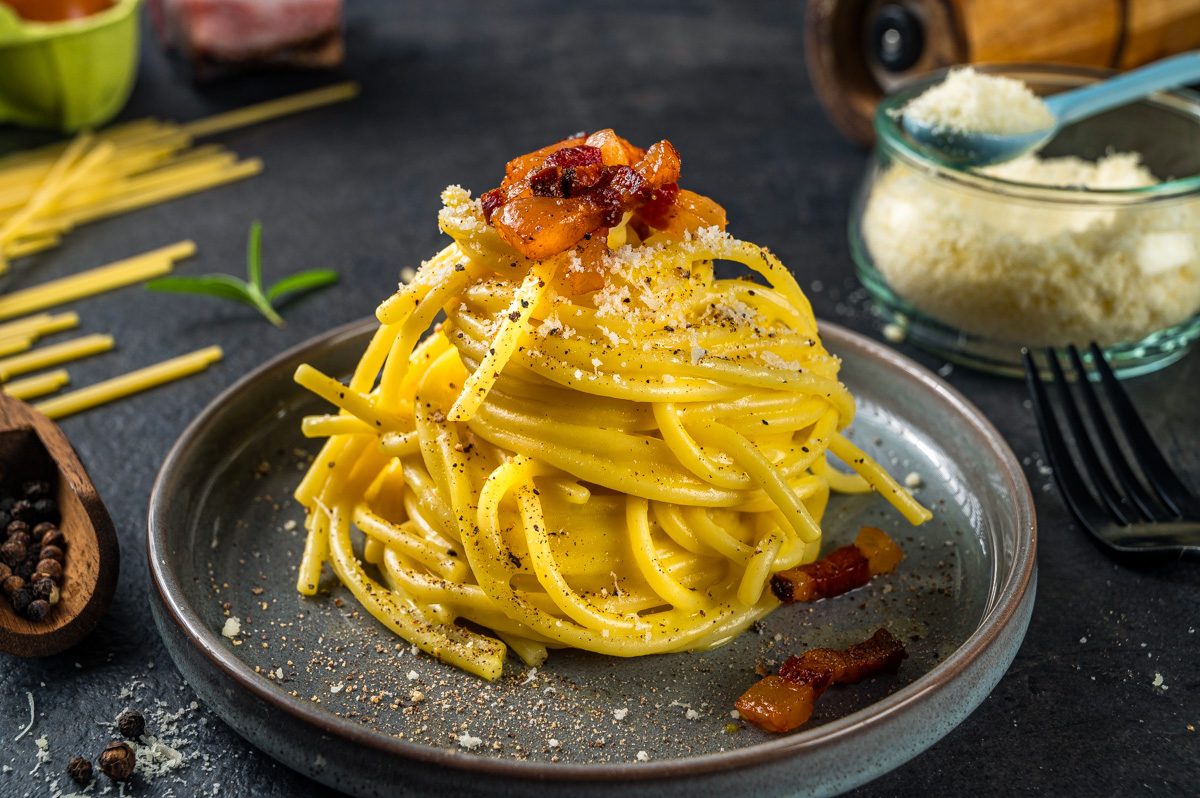

Pasta Carbonara is a classic Italian dish, the calling card of Lazio and Rome. A hearty, aromatic pasta in a creamy sauce with crispy bits of guanciale and freshly ground black pepper — this is the dish that makes you want to return to the Eternal City again and again.
At the same time, Carbonara is considered the most falsified dish outside of Italy. Most recipes I've encountered are capable of giving Romans a heart attack. Well, I once made it myself with cream and onions (just don't tell the Italians about that 😅). In my opinion, the reason for such diverse interpretations lies in the history of this dish's origin. But now, after working in an Italian restaurant for some time and preparing hundreds of servings, I can confidently say that I know how to make it properly, and I've described the process in detail below.
Additionally, I did some research on the dish's origins and history, and I'm happy to share it with you.
History of Pasta Carbonara
History of carbonara is so convoluted that even Italians themselves couldn't agree on a single version. There are 3 well-liked theories about Carbonara's origin.
Post WWII Theory
It describes how the progenitor of the original Carbonara was created by a Roman chef in 1944 upon the Allied liberation of Rome. By combining Italian pasta with eggs and bacon familiar to Americans in one dish, the original carbonara plate was born. This is a hypothesis that is true because Italian residents were experiencing shortages of food supplies at the time. The shortage was often supplemented by American food rations, such as dried yolk egg and smoked bacon.
Charcoal Burners (Carbonari) Theory
According to this theory, the dish was invented by charcoal burners who worked in the Apennines (Lazio-Abruzzo). They made a rich pasta with products that were locally available. Hence, the name "Carbonara."
Neapolitan Theory
It is based on the reality that in Francesco Palma's treatise "Il principe dei cuochi" issued in 1881, it mentions a Neapolitan pasta covered with Parmesan cheese, eggs, lard, and pepper.
First Mentions
Surprisingly, in contrast to Amatriciana and Gricia, Carbonara is not found in Ada Boni's classic 1930 book "Roman Culinary Guide."
The first written mention of Pasta Carbonara was made in 1952 in the USA, published by Patricia Bronte in a guide to Chicago restaurants. In Italy, it was first printed in 1954 in La Cucina Italiana pages. It had eggs, bacon, Gruyère cheese, and garlic.
It wasn't until 1960, in "La grande cucina," that a recipe was published that used guanciale.
Modern Carbonara: Authenticity and Ingredients
It has only been 72 years since Pasta Carbonara was first named. This relatively young dish, however, has conquered the world and become one of the precious jewels of Italian cooking. Classic carbonara is an impeccable mix of tastes and textures in which every component occupies its own position. Classic modern Italian recipe uses 5 components: guanciale, eggs, Pecorino Romano, pasta, and ground black pepper.
Golden Ratio for 1 Serving
For 1 serving we'll need:
- 2.8-3.5 oz (80-100 g) of dry pasta;
- 1 egg yolk per person, plus 1 whole egg for the pan;
- 1-1.2 oz (30-35 g) of guanciale;
- 0.7-1 oz (20-30 g) of Pecorino Romano;
- 1-2 tablespoons of fat from guanciale.
Thus:
- 1 serving = 3.5 oz (100 g) pasta, 1 whole egg, 1 yolk, 1.2 oz (35 g) guanciale and 1 oz (30 g) pecorino;
- 2 servings = 7 oz (200 g) pasta, 1 whole egg, 2 yolks, 2.5 oz (70 g) guanciale and 2.1 oz (60 g) pecorino.
This dish is prepared very quickly, and timing and speed are critically important for it. Therefore, all ingredients need to be prepared in advance and each stage should be correctly calculated.
Ingredients for 2 portions
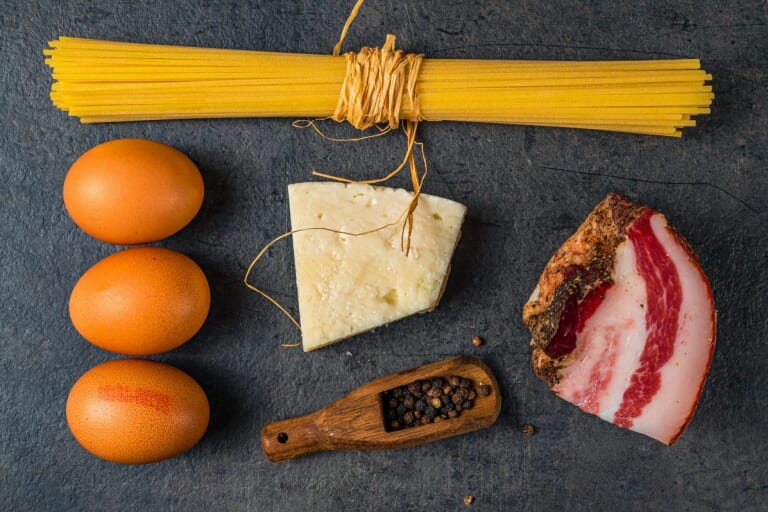
- 7 oz Spaghetti (200 g)
- 2.5 oz Guanciale (70 g)
- 2.1 oz Pecorino Cheese (60 g)
- 1 Eggs
- 2 Egg yolks
- 3 pinch Ground black pepper
Authentic Spaghetti Carbonara Recipe

Cut the guanciale into uniform medium-sized strips: about 1-1.2 inches (2.5-3 cm) long and 0.2 inches (5 mm) wide. This size will ensure even frying without drying out.
If desired, you can cut the guanciale into 0.3-inch (7-8 mm) cubes, but strips are preferable as the pieces will have an equal ratio of fat to meat layers.
Important: The fat of the guanciale should be white. Yellow parts of fat indicate that the product was not stored properly. Such pieces should be trimmed off as they can give the dish an unpleasant sour taste.
Nuance: Remove the tough skin right away. You can freeze it or add it to meat broth for a more vibrant and rich flavor. Also, trim off the edge that's generously sprinkled with pepper to prevent the dish from becoming too spicy.

Place the sliced guanciale in a dry, cold pan and fry it over medium heat until translucent, for 1-2 minutes. Then reduce the heat to a minimum and fry it until beautiful golden-brown, stirring for even browning. Don't forget to stir the pieces so they brown evenly on all sides. The guanciale should slowly simmer and become crispy on the outside while remaining soft inside. This will take about 10-15 minutes
Remove the browned pieces with a slotted spoon into a separate container and set aside.
As a result, a lot of fat will remain in the pan, which is the base for a delicious, aromatic, and creamy sauce. Leave 3-4 tablespoons of fat in the pan, and drain the rest into a separate container. The remaining lard can be used for making piadina or other dishes.
Important: The guanciale should not brown too much or burn. If the temperature is too high, the fats start to burn and acquire bitter, unpleasant notes. This causes the guanciale to lose its unique aroma, and the finished dish becomes heavier.
Also, don't keep it on the fire for too long and overdry the pieces. Due to prolonged heat treatment, too much fat renders out, and the meat layer becomes dry, hard, with a dark crust.
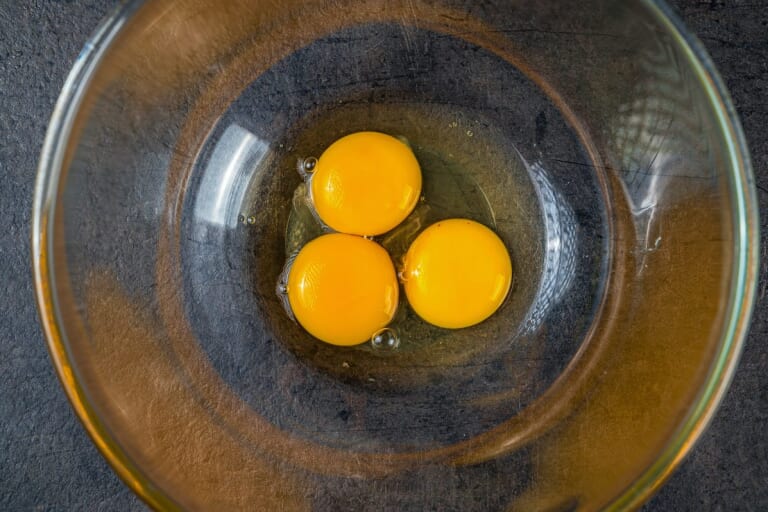
Crack 1 whole egg into a separate bowl. Then add 2 chicken egg yolks.
Important: The eggs should be at room temperature and fresh. Before cooking, they need to be thoroughly washed with dish soap and a sponge.
Tip: The remaining egg whites can be frozen or used to make meringue, Estonian cake, or angel food cake.
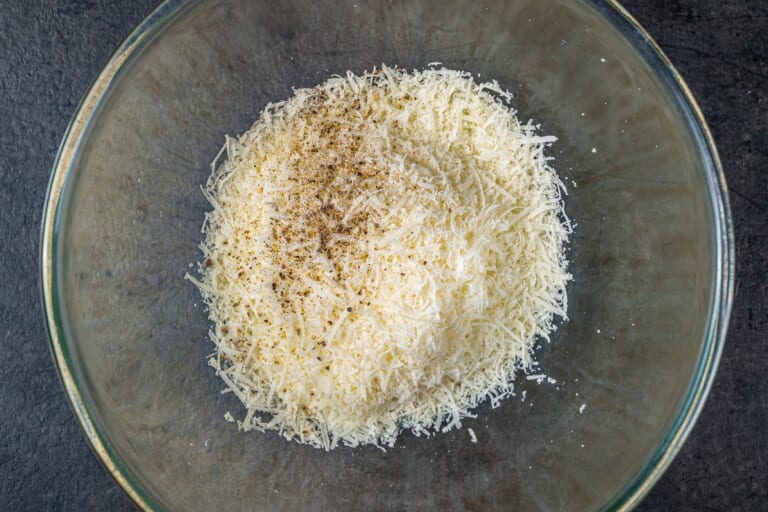
Add finely grated Pecorino and freshly ground black pepper to the eggs.
Tip: It's best to grate Pecorino using the finest grater, a Microplane, or a food processor. Ideally, the cheese should be like snow: the finer it's grated and the more powder-like it is, the faster it will start to melt, forming a creamy sauce.
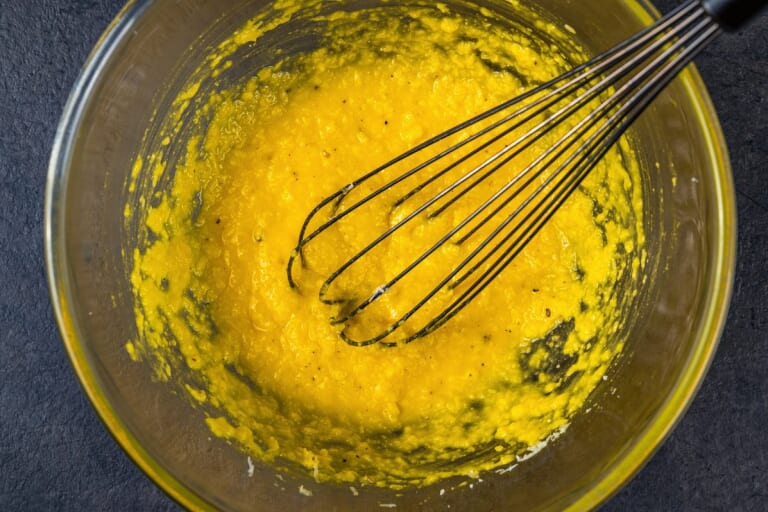
Mix the eggs with the cheese until you have a uniform, creamy consistency. It's easiest to do this using a whisk, but you can also use a regular fork.
Nuance: The finer the Pecorino is grated, the more homogeneous the mixture will be.
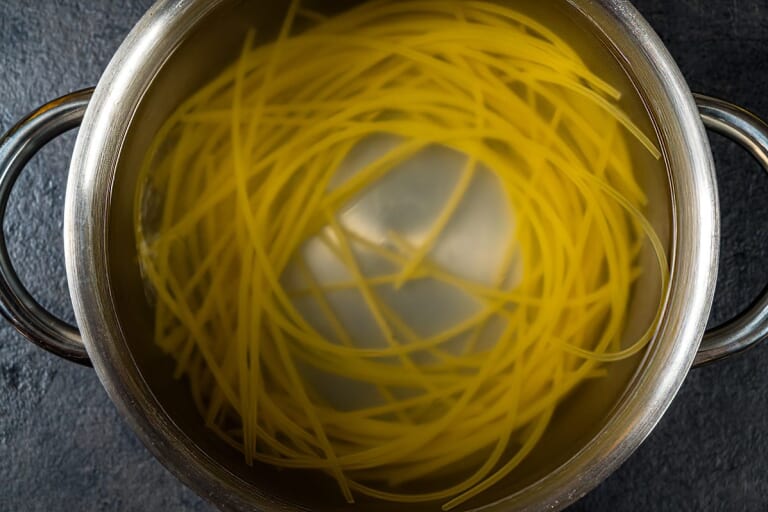
Meanwhile, cook the pasta in salted boiling water until al dente. To do this, cook the pasta for 2 minutes less than indicated on the package. If the package says 10 minutes, remove it from the water 8 minutes after it starts boiling. This is crucial, as the pasta will finish cooking in the pan. Italians test the pasta with their teeth to determine if it's ready: if there's no white dot in the center when you bite into a piece of pasta, it's ready.
Drain the pasta, making sure to reserve 1 cup of the pasta cooking water, we'll need it later.
Tip: To cook delicious pasta, use the Italian Rule of 1110. This rule also helps us obtain starch-rich cooking water, which is ideal for emulsifying sauces.
To cook tasty pasta, for every 3.5 oz (100 g) of dry pasta, add 4 1/4 cups (1000 ml) of water and 2 teaspoons (10 g) of salt.
Note that for carbonara, it's better to add less salt (1-1 1/2 teaspoons (5-7 g) per 3.5 oz (100 g) of pasta), as guanciale and Pecorino are quite salty.
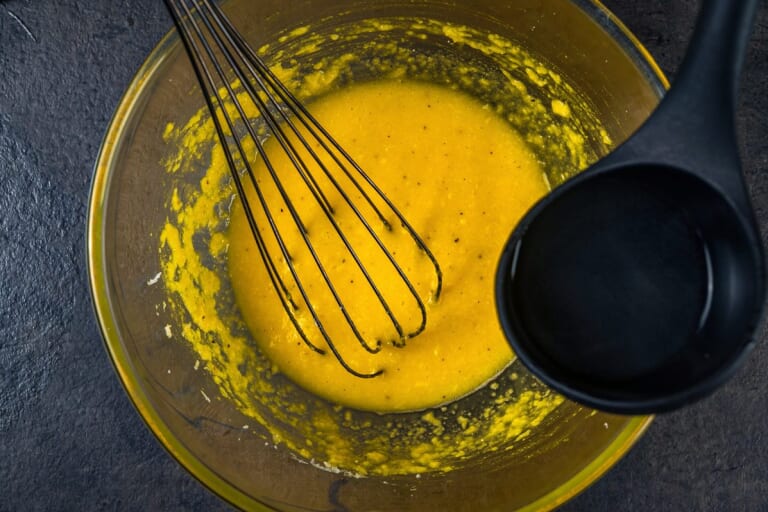
Slowly drizzle 2-3 tablespoons of the hot pasta water into the egg sauce while stirring constantly.
This way, we raise the temperature of the egg yolks before adding them to the hot pan. Thanks to this tempering, the eggs won't curdle from temperature shock. The starch contained in the pasta water, in turn, slightly increases the temperature threshold at which eggs begin to curdle.
Important: The resulting cream should not be watery, so add the starchy water gradually.
Nuance: In many Italian recipes, instead of water, a few tablespoons of hot guanciale fat are added to the eggs. This makes the sauce more creamy, thick, shiny, and velvety. If desired, you can add 1-2 tablespoons of fat and 1-2 tablespoons of starchy water.
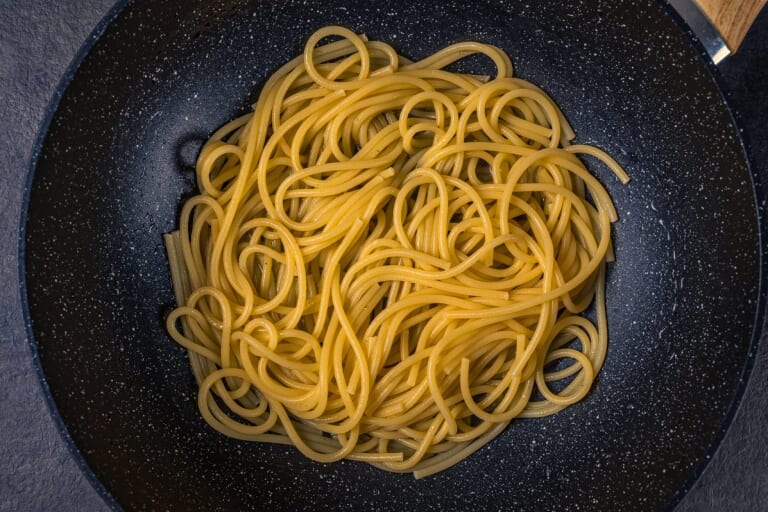
Pour 2-4 tablespoons of starchy water into the pan with the fat. Then add the al dente spaghetti. It's easiest to do this using spaghetti tongs.
Continue cooking the spaghetti over low heat, stirring constantly, until each strand is coated with a mixture of fat and starchy water. This will take 1-2 minutes.
At this stage, you can clearly see how the fat and water start to turn into an emulsion, combining into a velvety sauce.
Important: The amount of water should be moderate. If you've added too much cooking water, evaporate the excess liquid before adding the egg mixture.
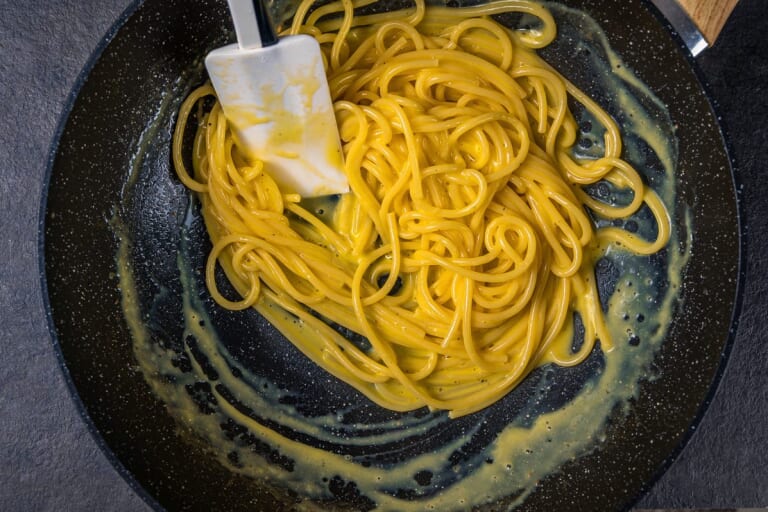
Now we move to the most crucial stage — adding the egg cream.
Remove the pan from the heat, let it cool for 10-20 seconds, stirring the pasta to remove excess heat. Then pour in the egg-cheese mixture, constantly stirring. Continue until the yolks, Pecorino, and water combine into a uniform, creamy sauce of medium thickness, with a consistency resembling custard.
At first, the sauce will be slightly lumpy; gradually, the Pecorino will melt completely, and the sauce will become uniform and slightly liquid. Its wateriness depends primarily on the amount of water. As you stir and heat, the sauce will begin to thicken quite quickly.
The finished sauce is not watery and doesn't run to the bottom; it's creamy, smooth, uniform, and sticks well to the pasta, leaving traces on the surface of the pan.
Tip: If the sauce is too thick, you can add a bit of hot pasta water.
Tip: If the sauce is too liquid and doesn't set when stirring, there are two reasons for this: too much cooking water or too low temperature. To thicken the sauce, return the pan to low heat, continuing to stir the sauce. But be careful and monitor the heat level to prevent the yolks from curdling.
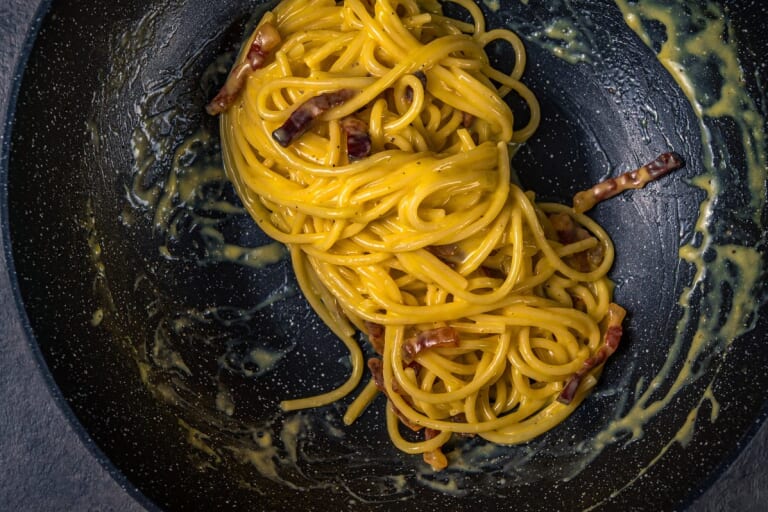
Lastly, add the browned guanciale to the pan, mix well, and serve. This way, the guanciale will remain crispy and add extra texture to the carbonara.
Important: Serve the finished pasta immediately. Due to the residual heat in the pan, the cooking process will continue, and the sauce will become too thick, dry, and dense.
Tip: You can reserve a few pieces of guanciale to garnish the finished dish.
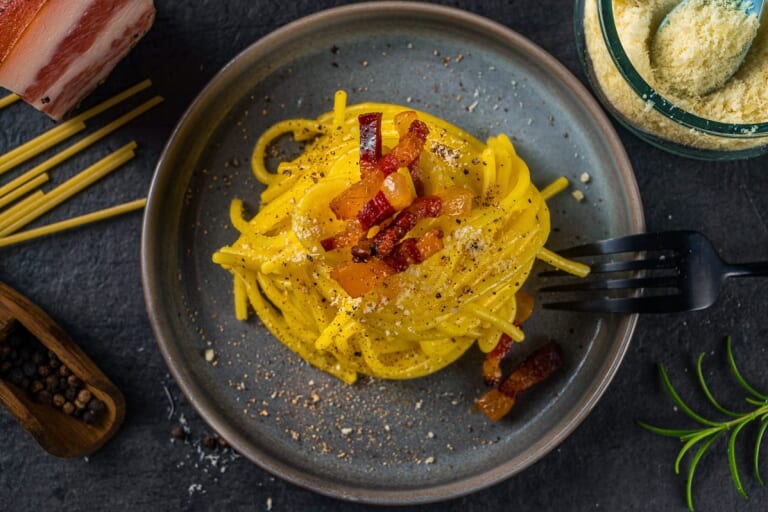
The Pasta Carbonara is ready.
Divide the spaghetti into warm individual plates, sprinkle with grated Pecorino, freshly ground black pepper, garnish with crispy slices of guanciale, and serve immediately.
Important: The carbonara sauce sets quickly as it cools. Therefore, the spaghetti should be served as quickly as possible.
Tip: To slow down the setting of the sauce, serve the carbonara in warm serving bowls. This will allow the pasta to retain heat longer, remaining juicy and creamy. To warm the bowls, place the entire stack in the microwave for 1-1.5 minutes or in an oven preheated to 140-175°F (60-80°C) for 10 minutes.
Tip: The easiest way to serve spaghetti is by using a deep ladle and culinary tongs. Instead of tongs, you can use a long-tined fork or chopsticks.
How To Make Real Carbonara Video Recipe
Recipe Tips
Ingredients and Substitution
Guanciale
Guanciale is a cured pork cheek generously seasoned with black pepper and salt. It has a unique, authentic aroma and gives carbonara a special flavor. Because this part of the pig has a large layer of fat, it releases a lot of fat when fried. Therefore, we don't need to add oil.
How to choose the perfect guanciale Outside of Italy, it can be difficult to find this product, but if you manage to, pay attention to the following criteria when choosing:
aged for at least 3-4 months: the longer the pork cheek matures, the more aromatic and flavorful it becomes;
choose pieces with 1-2 layers of red meat, not just a slice of fat;
prefer a whole piece rather than sliced and packaged: the size and quality of the cut are very important;
the fat of guanciale should be white, not yellow.
Believe me, classic carbonara is worth spending time to find typical Italian products.
Guanciale, pancetta, or bacon Whenever possible, we give preference to guanciale. If it's not available, we use pancetta and, as a last resort, we buy bacon.
In our choice, we rely on 2 criteria:
the fat that renders out during frying. There should be plenty of it, as it forms the basis of flavor and taste for our sauce;
the aroma and flavor that the product imparts to the dish.
Guanciale wins in both cases: it's fatty enough, has an authentic taste, and the necessary amount of salt and spices to season the sauce.
Pancetta is cured pork belly, very similar to guanciale in preparation method and also has an authentic taste, but it has a larger meat layer. Therefore, it releases less fat and requires more delicate frying to avoid drying out the meat layer.
Bacon has quite different flavor properties. It's smokier and releases little fat when fried. Moreover, it requires more intense heat treatment to become crispy and reveal its full flavor. When using bacon, we may need to add vegetable oil to the pan, which will also affect the final taste of the dish.
Eggs
The main task of eggs is to help combine fats and liquid into a creamy sauce. Therefore, the second most popular debate about carbonara concerns the use of whole eggs, yolks, and their ratio.
In my view, to understand which ratio is best to use for the recipe, you need to understand the role each of them plays.
Yolk
What the yolk affects:
Consistency and texture. Thanks to the lecithin contained in egg yolks, emulsification occurs, combining fats and liquid into a creamy, silky, smooth sauce. As a result of cooking the yolks, we get a fairly thick sauce that adheres well to the pasta surface.
Flavor. It becomes richer, more nutritious, and more intense.
Color. The more saturated the yolk color, the brighter and more yellow the finished pasta will be.
White
What the white affects:
Consistency and texture. The white adds lightness to the sauce, and conalbumin gives it the necessary viscosity and density. However, the more whites in the sauce, the more liquid and less creamy it will be.
Graininess. Too much white can lead to curdling, and the sauce texture will become grainy. The white begins to curdle at 140°F (60°C), so controlling the cooking temperature is very important.
Flavor. A large amount of white can give the dish a more eggy taste.
Thus, the ratio of whites to yolks can vary depending on your taste preferences and goals. Most recipes suggest using a combination of whole eggs and yolks. For example, 1 whole egg for every 2 yolks.
Personally, I prefer to add 1 whole egg as a base (for the pan), + 1 additional yolk for each portion of pasta: 1 egg and 1 yolk = 1 portion; 1 egg and 2 yolks = 2 portions; 1 egg and 3 yolks = 3 portions.
Pecorino
Pecorino Romano is an aged sheep's milk cheese with a very intense, piquant-salty flavor. It is the foundation for 4 classic Roman pasta dishes: Amatriciana, Carbonara, Cacio e Pepe, and Gricia. Therefore, for any resident of Lazio, replacing this key ingredient is blasphemy. In fact, there are good reasons for this: the taste of sheep's milk Pecorino is so pronounced that replacing it will change the flavor of the finished dish.
Pecorino or Parmesan
If you don't like the intense flavor of aged Pecorino, you can soften it by adding 30-50% Parmesan or Grana Padano cheese. Even in Italian recipes, combinations of Pecorino and Parmesan cheese are often found for a milder taste.
No pre-grated cheese packets
Always grate the cheese by hand. Never use packets of pre-grated cheese. Firstly, you can't be sure of its composition. Secondly, anti-caking agents are added to prevent the cheese from clumping during storage, resulting in poor melting and emulsification.
Pasta
Spaghetti is the classic choice for carbonara, with rigatoni being the second most popular type of pasta in Lazio.
Spaghetti
Considered preferable due to its long shape and ability to be evenly coated with a thin layer of creamy sauce. It's best to use medium-sized products, #5 or #7. The taste of spaghetti alla carbonara is milder and more balanced.
Rigatoni
This is a short, wide pasta with ridged edges that can hold more sauce. Because of this, the taste of the finished dish becomes more intense and concentrated.
Other types of pasta Tonnarelli, spaghettoni, bucatini, mezze maniche, and paccheri are also often used for cooking.
The choice of pasta depends on the result you want to achieve: long pasta gives a milder taste, while short pasta gives a more intense and concentrated flavor.
Not recommended I don't recommend using short pasta with small holes and very intricate shapes. Such shapes tend to retain a very large amount of sauce, resulting in a dish that is too intense, concentrated, and salty.
It's also worth avoiding pasta with high starch content, which makes the sauce too thick and sticky.
Black pepper
The black pepper should be freshly ground. To make its aroma more vibrant and intense, you can pre-heat the peppercorns in a dry pan for about 1 minute. Remove the pepper from the heat as soon as it starts to smell fragrant.
If you don't like pepper, you can omit it. If desired, it can be replaced with white pepper, but this is a deviation from the classic recipe.
Other additions
White dry wine
Wine is not part of the classic pasta carbonara recipe, but it helps break down fats, which promotes their emulsification. As a result, the dish becomes more balanced and less fatty.
After you've removed the guanciale pieces from the pan, you can deglaze it with a small amount of dry white wine (1-3 tablespoons).
Cream
To the question of whether cream should be added to pasta carbonara, there is a definite answer - no! We get the creamy texture of the sauce as a result of cooking the yolks and emulsifying fat and water during the stirring process (mantecatura). Cream makes the pasta more fatty, oily, and negatively affects its taste.
In some hotels, a little cream is indeed added to the sauce to maintain its creamy consistency until serving. We serve hot pasta immediately, so we don't need this trick.
Onion and garlic
There should be no fried onion and garlic in pasta carbonara. The five key ingredients make the taste of carbonara balanced. Therefore, it doesn't need additional products with intense flavors.
Chili pepper
No chili in carbonara. Black pepper, spicy guanciale, and pecorino season the pasta well, making it spicy enough. If you want more heat, add another pinch of ground black pepper.
Which pan to choose for pasta carbonara?
In Italy, you can find special saltapasta pans or mantecare pans that are designed for cooking pasta. This is a large, wide non-stick pan with high, smoothly rising sides, which is very convenient for stirring the contents on the fly.
The main feature of this pan is that it has relatively thin walls that distribute heat very moderately, without overheating the contents. For carbonara, moderate heat distribution is a critically important factor, so try to choose thin-walled cookware whose surface cools down fairly quickly, otherwise it will be difficult for you to control the sauce preparation at the last stage.
For example, my saltapasta allows me to cook pasta on low heat from start to finish without removing it from the stove.
Avoid cast iron and thick-walled cookware. If you have to cook in these, remove them from the heat in advance and let them cool down a bit before adding the egg mixture.
What to do if carbonara turns into an omelet?
Even I experience this sometimes if I break one of the key rules. Yes, carbonara in the form of an omelet isn't very attractive, but it's still tasty, aromatic, and filling. Just consider your experience next time, and you'll succeed.
To get a velvety sauce instead of an omelet, consider three factors:
Temperature
It should be moderately hot. At temperatures above 149-158°F (65-70°C), the eggs will turn into an omelet; at temperatures below 131-140°F (55-60°C), the sauce will remain liquid.
In addition to the heating temperature, it's important to consider the thermal conductivity of the pan. The more heated it is and the longer it retains heat, the more time it needs to cool down before adding the egg sauce.
Time
While the sauce is in the pan, it continues to cook due to residual heat. It's important to catch the moment when the sauce is still thick but consider that once in the plate, it will thicken and set even more.
Speed
Constant stirring of the sauce:
- promotes even heat distribution and warming of the yolks;
- minimizes contact of the sauce with the hot surface;
- ensures proper tempering of the yolks and the emulsification process.
Personally, I cook carbonara on low heat directly on the stove. But before deciding whether to remove the pan from the stove, you need to consider two factors:
- the characteristics of your pan;
- your skills.
For better temperature control, you can alternately remove and return the pan to the heat. Focus on the consistency and appearance of the sauce, not on specific time frames specified in the recipe.
Wine for Carbonara
Carbonara is a rather rich and fatty dish, so it pairs well with a light white wine that will help balance the flavor. The following wines are well-suited for this purpose:
- Chardonnay;
- Vermentino;
- Greco di Tufo;
- Sauvignon Blanc;
- Frascati;
- Pinot Grigio;
- Gavi;
- Fiano.
Whatever wine you choose, the main thing is that it should not be heavy and should not overpower the taste of the main dish.
Egg yolk tempering method for perfect sauce
To pasteurize the eggs and achieve the perfect sauce consistency, you can use a double boiler. In addition, this method allows better temperature control and minimizes the risk of turning eggs into an omelet.
To do this, place the eggs, grated cheese, and ground black pepper in a suitable bowl. Constantly stirring, temper the yolks by adding the guanciale fat and a little hot pasta cooking water to them. Place the container in a double boiler so that it doesn't touch the boiling water, add the al dente spaghetti and continue to stir vigorously. The sauce should heat to a temperature of 142°F (61°C) and thicken to the desired consistency.
Pasteurization of yolks occurs at a temperature of 140-144°F (60-62°C). The consistency of the finished sauce will be uniform, creamy, and velvety, without lumps of curdled egg.
This is a universal method for cooking egg sauces, used by chefs such as Luciano Monosilio, "The King of Carbonara".
Frequently Asked Questions (FAQ)
Should I add cream to Spaghetti Carbonara?
No. Authentic carbonara achieves its creamy texture solely through an emulsion of eggs, cheese, starchy pasta water, and rendered fat. Adding cream is considered a cardinal sin in Roman cuisine and masks the flavor of the ingredients.
Can I use bacon instead of Guanciale for Carbonara?
Yes, you can use bacon if Guanciale (cured pork cheek) is unavailable. However, choose high-quality thick-cut bacon or Pancetta. Keep in mind that bacon has a smokier flavor compared to the savory, funky depth of traditional Guanciale.
Can I use Parmesan instead of Pecorino Romano?
Yes. While Pecorino Romano is traditional and provides a sharp, salty kick, you can substitute it with Parmigiano Reggiano for a milder, nuttier flavor. A popular compromise is to use a 50/50 mix of both cheeses.
How do I prevent eggs from scrambling in Carbonara?
Scrambling happens when the heat is too high (above 158°F/70°C). To prevent this, always remove the pan from the heat before adding the egg mixture (tempering), and use starchy pasta water to stabilize the emulsion while stirring constantly.
What wine pairs best with Carbonara?
Carbonara pairs best with acidic white wines that cut through the richness of the dish. Excellent choices include Chardonnay, Pinot Grigio, Frascati, or a crisp Sauvignon Blanc.
Leave a Comment